
You sit beside your child to help with homework. Within minutes, they are looking around the room, playing with a pencil or asking to do something else. You remind them to focus, they return to the task, and a few minutes later, the same thing happens again.
If this sounds familiar, it is understandable to feel concerned or frustrated. You may wonder whether your child is simply distracted, struggling with schoolwork or showing signs of attention-deficit/hyperactivity disorder (ADHD).
Difficulty concentrating does not automatically mean a child has ADHD. Sleep problems, stress, anxiety, learning difficulties and environmental distractions can also affect attention. Understanding the pattern behind your child’s behaviour is more helpful than jumping to conclusions.
Is It Normal for Children to Struggle With Concentration?
Yes. Children’s attention spans develop as they grow, and their ability to concentrate varies with age, interest, tiredness and the task itself.
A child may focus for a long time on a favourite game but struggle with a difficult homework assignment. Occasional distraction is not necessarily a cause for concern.
However, if your child consistently struggles to follow instructions, complete age-appropriate tasks or stay focused across different situations, it may be worth exploring further. Changes from their usual behaviour also deserve attention.
What Can Cause Concentration Problems in Children?
Several factors can contribute when a child is not concentrating.
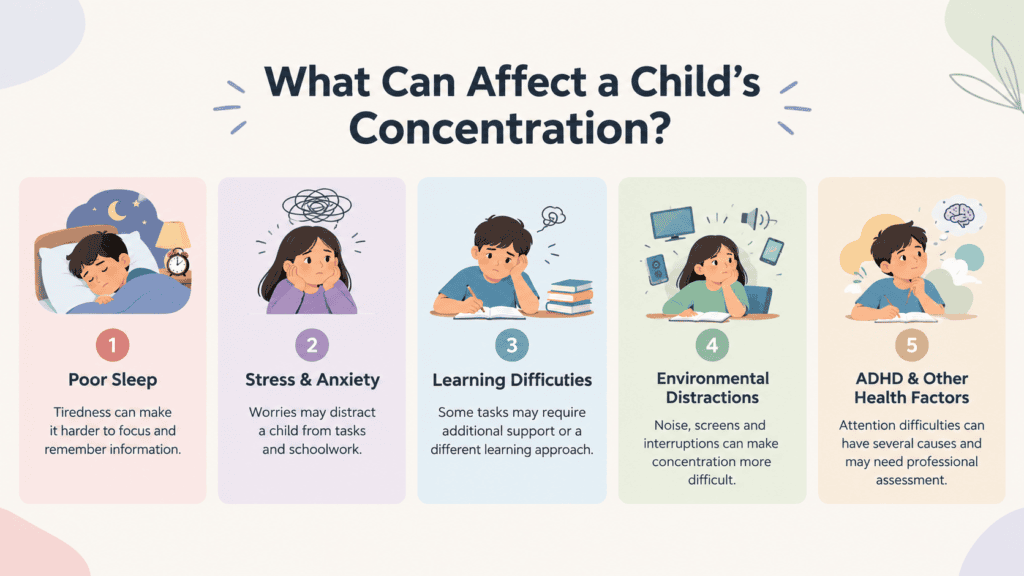
Rather than assuming a child is being careless or uncooperative, try to understand what might be making the task difficult.
Could Difficulty Concentrating Be ADHD?
ADHD is a neurodevelopmental condition that can affect attention, activity levels and impulse control.
Children with ADHD may frequently lose track of instructions, forget everyday tasks, become easily distracted, interrupt others or struggle to remain seated when expected. Some primarily experience difficulties with attention, while others show hyperactivity and impulsivity or a combination of these patterns.
However, one symptom, a restless afternoon or a teacher’s observation alone is not enough to diagnose ADHD.
For an ADHD diagnosis, symptoms must be persistent, inconsistent with the child’s developmental level and associated with meaningful difficulties in daily functioning. Several symptoms must be present in more than one setting, such as home and school.
Can Anxiety, Stress or Poor Sleep Affect a Child’s Attention?
Yes. A child who is worried about an exam, friendship problems or something happening at home may find it difficult to focus on lessons. They may appear distracted because their attention is occupied by something else.
Poor sleep can also make children irritable, restless or unusually tired, affecting their ability to learn and follow instructions. Learning difficulties may create a similar pattern when a child repeatedly struggles with work they do not understand.
These possibilities matter because the right support depends on the underlying cause. Treating every concentration problem as ADHD could mean overlooking another difficulty that needs attention.
What Signs Suggest Your Child Needs an Assessment?
Consider seeking professional advice if:
- Concentration difficulties continue over time rather than occurring occasionally.
- Your child regularly struggles to complete schoolwork or follow instructions.
- Teachers and caregivers notice similar concerns in relevant settings.
- Academic performance, friendships or family life are being affected.
- Your child becomes distressed, frustrated or loses confidence despite appropriate support.
You can ask your child’s teacher what they observe in the classroom and whether the difficulties occur during particular subjects or activities. These details can help identify useful next steps.
How Is ADHD Assessed in Children?
A qualified clinician may review your child’s developmental history, medical background, behaviour and everyday functioning. They may also gather observations from parents and teachers, using appropriate rating scales where helpful.
The assessment considers whether symptoms occur across settings and whether other explanations, such as anxiety, sleep difficulties or learning problems, may be contributing. There is no single test that independently establishes an ADHD diagnosis.
What Support Can Help?
Support depends on your child’s individual needs and the cause of their concentration difficulties. It may include:
- Parent guidance and behavioural strategies: Clear instructions, predictable routines and positive reinforcement can help children manage tasks.
- School-based support: Breaking assignments into smaller steps, reducing distractions and allowing appropriate breaks may improve participation.
- Support for underlying difficulties: Sleep problems, anxiety and learning challenges may need specific attention.
- ADHD treatment: When ADHD is diagnosed, evidence-based care may include behavioural support, school interventions and medication when clinically appropriate.
These approaches should be tailored to the child’s age, needs and circumstances.
When Should Parents Seek Professional Help?
If your child’s concentration difficulties consistently interfere with learning, relationships or emotional wellbeing, consider speaking with a qualified mental health professional. A child and adolescent psychiatrist can help assess possible causes and discuss suitable support.
You do not need to wait for school performance to decline significantly before seeking guidance.
Frequently Asked Questions
Does difficulty concentrating mean my child has ADHD?
No. Sleep problems, stress, anxiety, learning difficulties and other factors can affect concentration. ADHD requires a comprehensive clinical assessment.
At what age can ADHD be assessed?
ADHD can be assessed in childhood when symptoms and developmental concerns warrant it. The appropriate approach depends on the child’s age, history and functioning.
Can screen time affect a child’s concentration?
Screen use may contribute to difficulties when it displaces sleep, physical activity or focused activities. However, concentration problems should be assessed in context rather than attributed to screens alone.
Should I speak to a child psychiatrist or school counsellor?
A school counsellor can help identify classroom concerns and possible learning support. A qualified clinician, such as a child and adolescent psychiatrist, can assess persistent difficulties and consider medical or mental health explanations.
Helping Your Child Focus Starts With Understanding
When a child struggles to concentrate, repeated reminders to pay attention may not address the underlying difficulty. Understanding the factors affecting a child’s attention can help parents respond with patience and recognise when additional support may be beneficial.
HappyMindz Clinic, based in Rohini, Delhi, provides mental health care and support for individuals experiencing a range of emotional and psychological concerns. Dr. Neha Salhotra, Psychiatrist, is associated with the clinic and works in the field of mental health assessment and care.
Concentration difficulties can have several causes, including sleep problems, emotional stress and learning challenges. Every child’s experience is different, and considering their emotional wellbeing, developmental stage and everyday environment can help build a clearer understanding of their needs.
Note:This article is for educational purposes only and does not replace professional medical advice, diagnosis or treatment.