
A child who forgets homework, loses stationery, struggles to finish classwork or finds it difficult to sit still is not necessarily being lazy. Sometimes, these behaviours may be related to attention deficit hyperactivity disorder (ADHD).
ADHD is a neurodevelopmental condition involving persistent patterns of inattention, hyperactivity and impulsivity that can affect a child’s learning, relationships and everyday activities.
However, concentration problems do not automatically mean ADHD. Sleep difficulties, anxiety, learning differences and stressful experiences can also affect a child’s behaviour. Understanding the pattern, rather than judging individual incidents, is important.
What does ADHD look like in an Indian school setting?
Imagine a child who understands a lesson when the teacher explains it but regularly leaves written work unfinished. They may forget instructions, misplace notebooks, interrupt classmates or struggle to organise their school bag.
In an Indian classroom, where children may have long school days, multiple subjects, homework and regular assessments, these difficulties can become particularly noticeable.
A child with ADHD may:
- Miss parts of instructions, even when they appear to be listening.
- Make careless mistakes or leave questions unanswered.
- Forget homework, books or classroom materials.
- Struggle to complete tasks without repeated reminders.
- Become restless during lessons or frequently leave their seat.
- Interrupt conversations or find it difficult to wait their turn.
These behaviours can affect school performance, but they are not evidence of ADHD on their own.
What are the common signs of ADHD in children?
ADHD symptoms generally fall into three areas. Children may show signs from one or more areas, and their experiences can differ.
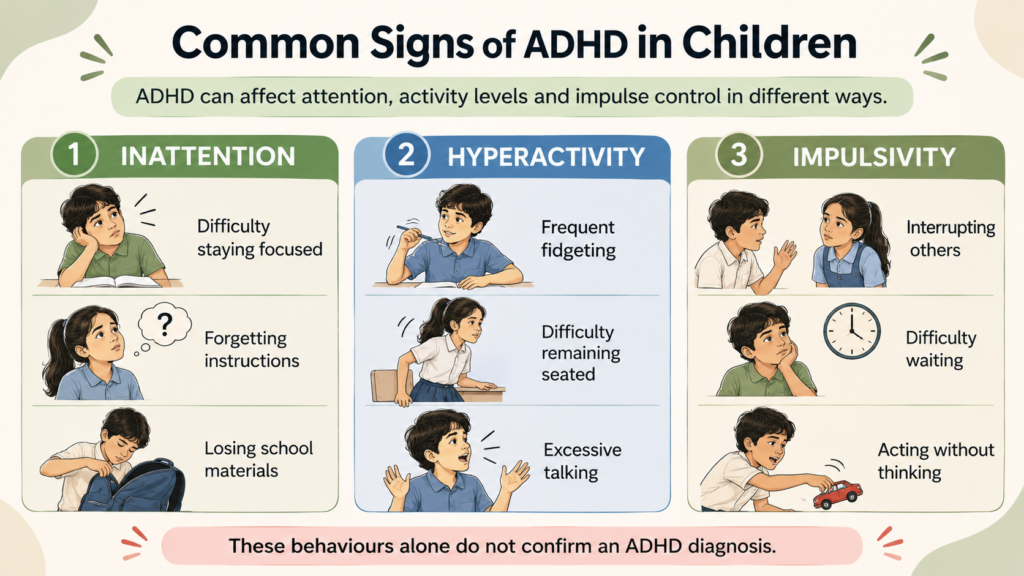
1. Inattention
A child may have difficulty sustaining attention, following instructions, organising tasks or remembering everyday responsibilities. They might start homework but move to something else before finishing it.
2. Hyperactivity
Some children appear constantly active. They may fidget, talk excessively, climb or move around when expected to remain seated. Other children may show less obvious physical restlessness.
3. Impulsivity
A child may interrupt others, answer before a question is finished, struggle to wait or act without considering the consequences.
Not every child with ADHD is visibly hyperactive. Some mainly experience difficulties with attention and organisation, which can be overlooked because they are quieter in class. NIMH
Is my child lazy, distracted or struggling with ADHD?
It can be frustrating when a child repeatedly forgets instructions or avoids homework, especially when parents feel they have explained the same thing many times.
But there is a difference between choosing not to complete a task and consistently struggling to organise, begin or finish it.
A child experiencing attention difficulties may genuinely want to complete their work but find it difficult to manage each step. Repeated criticism or comparisons with siblings and classmates can make them feel misunderstood.
This does not mean every unfinished assignment is a sign of ADHD. The important questions are whether the behaviour happens frequently, has been present over time, occurs in different settings and affects everyday functioning.
Can anxiety, sleep problems or learning difficulties look like ADHD?
Yes. Several concerns can affect a child’s attention and behaviour.
- Anxiety: A worried child may appear distracted because their attention is occupied by fears or ongoing thoughts.
- Sleep difficulties: Poor or insufficient sleep can affect concentration, memory and behaviour.
- Learning difficulties: Dyslexia or other learning differences may make reading, writing or classroom tasks particularly challenging.
- Stress: Changes at home, family conflict or academic pressure can affect a child’s ability to focus.
- Social difficulties: Bullying, exclusion or problems with classmates and teachers may lead to withdrawal, restlessness or reluctance to attend school.
Some of these concerns can also exist alongside ADHD. A proper assessment considers the whole picture rather than focusing on one behaviour. NIMH
How can ADHD affect homework, exams and friendships?
A child who struggles to organise tasks may spend much longer on homework than expected. They might understand a topic but forget to submit an assignment, skip questions or lose track of examination instructions.
Friendships can also become difficult. Interrupting, acting impulsively or struggling to wait for a turn may lead to misunderstandings with classmates.
Over time, repeated negative feedback can affect a child’s confidence. They may begin to believe they are not capable, even when they have the ability to learn and succeed.
Academic performance alone, however, cannot establish whether a child has ADHD.
How is ADHD assessed in children?
There is no single test that can confirm ADHD. Assessment involves understanding the child’s development, behaviour and difficulties across different areas of life.
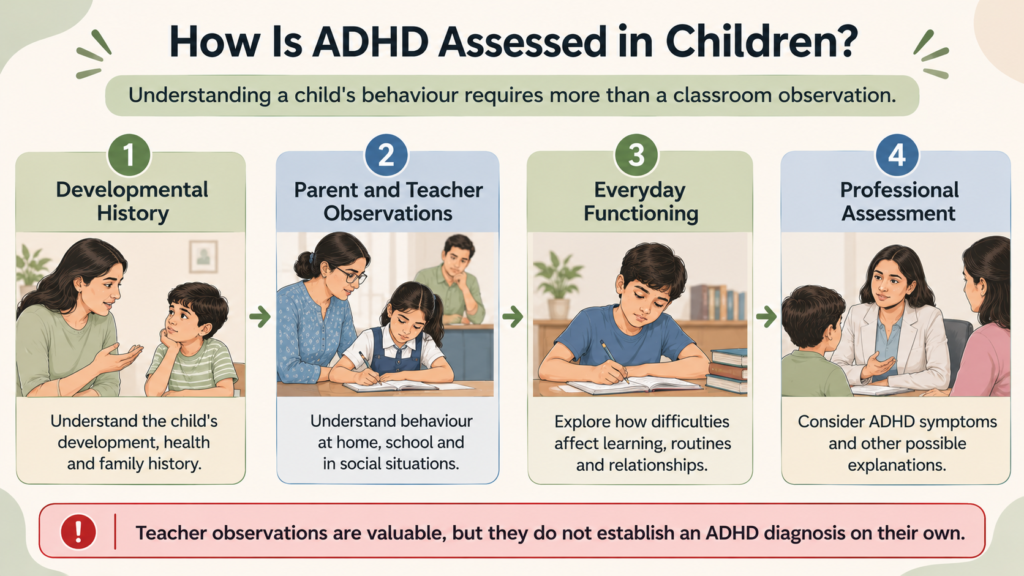
A qualified professional may:
- Discuss the child’s developmental, medical and family history with parents or caregivers.
- Explore when the difficulties began and how frequently they occur.
- Ask about behaviour at home, school and in social situations.
- Consider observations and reports from teachers, alongside information from parents.
- Assess possible learning difficulties, anxiety, sleep problems and other concerns.
Teacher observations are valuable because they show how a child manages classroom demands. However, a teacher’s report or a behaviour rating scale alone cannot establish an ADHD diagnosis. Symptoms and their impact need to be assessed across settings. NICE Indian Psychiatric Society guideline
What support can help a child with ADHD?
Support depends on the child’s age, needs and the difficulties they experience. It may include:
- Parent guidance: Practical ways to establish routines, give clear instructions and respond consistently to difficult behaviour.
- Classroom adjustments: Breaking larger tasks into smaller steps, reducing distractions and providing clear written instructions.
- Behavioural support: Helping children develop organisation, emotional regulation and everyday skills.
- Medication: A qualified professional may consider medication when clinically appropriate, alongside monitoring and other forms of support.
The aim is not simply to make a child sit still or behave like everyone else. It is to understand their needs and help them participate more comfortably in learning and everyday life.
When should parents seek a professional assessment?
Consider seeking guidance if attention, activity or impulsivity difficulties are persistent and noticeably affect your child’s learning, relationships, daily routines or emotional wellbeing.
It may help to speak with your child’s teacher and note specific examples of what you observe at home. If similar concerns appear in different settings, discussing them with a qualified professional can help clarify what is happening.
You do not need to wait until school performance becomes severely affected before asking for help.
Could something other than ADHD be affecting your child’s behaviour?
Difficulty concentrating or following instructions does not always mean ADHD. Bullying, dyslexia or other learning difficulties, stress at home, social exclusion, sleep problems and difficulties with teachers or classmates can also affect a child’s behaviour and school performance.
Try speaking with your child without making them feel responsible for the problem. Ask what they find difficult at school and whether anything is making them uncomfortable. A conversation with their teachers may help identify concerns that need educational support, classroom changes or further assessment.
Frequently asked questions
1. Can a child have ADHD and still do well in school?
Yes. Some children with ADHD perform well academically, particularly when their learning environment and support meet their needs. Academic achievement does not rule out ADHD.
2. Can ADHD symptoms be mistaken for laziness?
Yes. Difficulties with attention, planning and completing tasks may be interpreted as a lack of effort. Understanding the reasons behind the behaviour is more useful than labelling the child.
3. Do teachers need to be involved in an ADHD assessment?
Teacher observations can provide valuable information about classroom behaviour, attention and learning. However, teachers cannot establish an ADHD diagnosis on their own.
4. Can anxiety cause concentration problems in children?
Yes. Anxiety can affect attention, memory and the ability to complete tasks. It may sometimes resemble ADHD, which is why assessment should consider emotional wellbeing.
5. Does every child with ADHD need medication?
No. Support is based on the child’s individual needs. It may involve parent guidance, behavioural support, classroom adjustments and medication when clinically indicated.
Understanding a child’s behaviour begins with looking beyond labels. Children may need different kinds of support to learn, manage emotions and feel confident in their abilities.
HappyMindz Clinic in Rohini, Delhi, provides psychiatric care for children and adolescents, including concerns related to behaviour, attention and emotional wellbeing.